
Our electricity demands are increasing as we electrify our homes.
If our appliances were once powered by gas and are now powered by electricity, our electrical demand will increase.
In some cases, the extra demand will push the home’s power supply beyond its limits.
One solution to this is to upgrade to three-phase.
But given that three-phase can cost between $5,000 and $10,000 in Victoria, we thought it would be helpful to explain it in a bit more detail: what is it and do you really need it?
What is one-phase (single-phase)?
The majority of houses in Victoria are one-phase: there is one active wire coming from the poles and wires on our street to feed our home. The active wire carries the power into the house and a neutral wire completes the circuit back to the street.
What is three-phase?
Three-phase has 3 separate active wires and 1 neutral.
I thought about going into the technical detail, but decided to keep it simple and stick with the summary – three-phase results in more power being available to the house, more efficiently.
Here is a helpful summary from AJD Electrical.
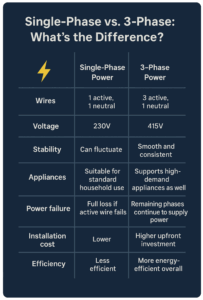
The problem I have with this summary is that a number of the benefits seem to be technical: are you the home owner going to notice if three-phase delivers power more efficiently to appliances? Probably not. You’ll be happy as long as your appliances are working.
For example, one of the benefits listed above is that remaining phases continues to supply power if one of the active wires fail. The chances of an active wire failing is highly unlikely. In this respect, three-phase seems to be very expensive insurance.
What’s two-phase?
Some houses and suburbs had two wires from the street – one for the house and one for the hot water. Some of our customers have “off-peak” hot water, which allowed energy distributors to shift energy usage to generally nighttime (midnight to 6am). Funnily enough, this has now changed – off-peak is during the day when the grid is full of cheap solar.
Two Key Takeaways
I think there are two key takeaways when it comes to three-phase.
The first key takeaway is some people will need three-phase.
If you have a large ducted heating system, a home cinema, a heat pump pool heater, a sauna, a fast EV charger, or a combination of these, you probably need three-phase. These appliances require a large amount of power and homeowners will likely need three-phase if they want to use these appliances, especially at the same time.
In fact, many ducted air conditioning systems will only go up to a certain size before they require three-phase power. Typically around 18kW is the tipping point. If you have a large house, you’ll need a large ducted heating system to heat all the rooms, so you’ll probably need three-phase.
The second key takeaway is don’t upgrade to three-phase until it’s absolutely necessary.
The majority of us don’t have these appliances list above. I recommend not upgrading to three-phase until you need them. For example, let’s assume you are speaking to an electrician about an EV charger. Let’s assume the electrician is recommending that the EV charger might push your power supply to the limits and you should consider three-phase. Unless the EV charger will definitely push you above, try installing it first and see if it works. The risk is that running the EV charger and your air conditioners, microwave, kettle, toaster, air fryer and heat pump at the same time will push your switchboard over the limit. If this happens, your switchboard will trip and you’ll need to reset it (which is very simple). If this happens regularly, it will become annoying.
But it might work. You might find you run the EV charger at different times to your other appliances and they cumulatively do not overload your switchboard. For me, this makes more sense before pre-emptively going to the expense of upgrading to three-phase.
Plenty of Powrhouse customers and others have fully electrified their homes without needing three-phase.
Solar
Some people have been convinced to upgrade to three-phase so they can export more solar to the grid. While it makes sense that 3 cables will allow more output than 1 cable, it’s a terrible basis for choosing three-phase. Everyone who has solar will be familiar with the diminishing returns of exporting solar. In New South Wales and Queensland they are even charging homes to export solar, so three-phase sounds like a formula to charge you three times as much.
Solar is simple – the key is to consume what your system produces.
Summary
One of the concerns I have with three-phase, as you can probably tell from the title of the article, is that enthusiastic electricians are selling three-phase to people who don’t need it.
If you are installing a large air conditioning system, EV charger and heat pump pool heating, then three-phase is an obvious and effective solution. But if you can get away without upgrading to three-phase, I think a step-by-step approach makes more sense.

 Subscribe to Our